

Alcohol Awareness Month

girl with head in hands with a bottle of alcohol

Since 1987, April has served as Alcohol Awareness Month, a time to examine how alcohol impacts our health, our families, and our communities. This year, the national focus is centered on a powerful new message: #ProofIsInTheNumbers.

While many view drinking as a simple way to unwind, the 2026 campaign invites us to take a closer look at the data and trends. From the rise in alcohol-related emergency room visits to a better understanding of long-term health risks, the goal this month is to move beyond stigma and toward informed, healthy choices.

More Than a Hangover: Understanding the Risks
One of the most significant emerging trends in public health data is the link between alcohol consumption and an elevated risk for cancer. While many associate drinking primarily with liver health, current research highlighted by the Surgeon General shows that alcohol consumption is linked to at least seven types of cancer, including breast, colon, and liver cancer.

The “proof” also shows up in other ways:

  • Impaired driving remains a leading cause of preventable accidents.
  • Scientific data show that alcohol use in young adults can interfere with vital brain maturation, impacting decision-making later in life.
  • Health experts are increasingly warning about the “dangerous overlap” between alcohol use and the opioid crisis, as mixing substances significantly increases the risk of fatal overdose.

The Rise of “No-and-Low”
It’s not all bad news. One of the most positive recent trends is the rise in popularity of high-quality non-alcoholic (and low-alcohol) options. We are seeing a shift in social norms where “mocktails” are no longer an afterthought, but the “go-to” drink in social settings.

The market is now filled with “No-and-Low” spirits, botanical elixirs, and sophisticated tasting menus that offer the social ritual commonly connected with alcohol use, but without the health trade-offs and risks. Choosing an alcohol-free lifestyle, or even just cutting back, has never been more accessible or socially supported.

The More Sober Generation
Another positive trend is that fewer young adults (age 35 and below) are drinking, and those who do consume alcohol tend to be drinking less. A 2023 survey from Gallup found that the number of adults under age 35 who report consuming alcohol has dropped ten percentage points over two decades, falling to 62% in 2021-2023 from 72% in 2001-2003. It’s becoming clear that today’s younger generations are more likely than older generations to see alcohol as a risk to their health.

How You Can Participate

  • Take an “Alcohol-Free Weekend”: Test the waters by going 72 hours without a drink. Notice how your sleep, energy, and mood change.
  • Educate Yourself: Look for the #ProofIsInTheNumbers hashtag online to find the latest toolkits on how alcohol policy and personal choices impact your local community.
  • Start the Conversation: Talk to your kids or younger family members. Data shows that parental disappointment is still the #1 reason youth choose not to drink; your voice matters.

Finding Support
If you or a loved one is finding it difficult to manage alcohol use, remember that Alcohol Use Disorder (AUD) is a treatable medical condition, not a moral failing. There are more resources available now than ever before, from telehealth counseling to community-based recovery groups.

Need Help?

SAMHSA National Helpline: Call 1-800-662-HELP (4357) for confidential, free, 24/7 information and treatment referral.

Manning Recovery Center: Consult with one of the experts in substance use disorder treatment by calling 1-712-655-2300 or learn more at manningrecoverycenter.com.

Alcoholism Impacts Everyone

Addiction impacts everyone

Brad MadsenBy Bradley Madsen, Recovery Clinical Coordinator

You may think you are too strong, or somehow immune to alcoholism. After all, ‘things like alcoholism happen to OTHER people, it can’t happen to ME.’ But it can. Working in the addiction field, I’ve met hundreds of people who once believed that alcoholism could never happen to them, until it did.

‘But I’m different, I’m a successful/professional person.’ Alcoholism doesn’t care what you do for a living or how much money you have in the bank. It doesn’t care what race you are or how educated you are. If you have recent patterns of abusing alcohol, you are at risk. Take these statistics for example:

  • Lawyers: One in five attorneys struggle with drinking problems – twice the national rate.
  • Healthcare: About 4% of healthcare workers reported heavy alcohol consumption in the prior month. A 2014 study found that 15.3% of physicians struggled with alcohol abuse or dependence.
  • Construction: 16.5% report drinking heavily in recent weeks.
  • Hospitality/Food Service: 11.8% report drinking heavily in recent weeks.
  • Management: Roughly 9% of ‘white collar’ professionals in management positions reported heavy alcohol use in the past month.
  • Real Estate: 5% report drinking heavily in recent weeks.
  • Finance/Insurance: 7.4% report drinking heavily in recent weeks.
  • Education: 4.7% report drinking heavily in recent weeks.
  • Farming: Alcohol abuse among farmers is as high as 32% (over 3 in 10).
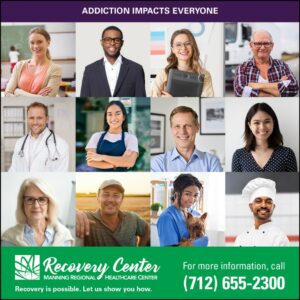
Addiction impacts everyone

I hope this illustrates the point that alcoholism truly does not discriminate.

Alcohol Awareness Month is a national public health awareness campaign sponsored by the National Council for Alcoholism and Drug Dependence (NCADD) that takes place every April. It was developed to increase awareness and understanding of the causes and treatment of one of our nation’s top public health problems: alcoholism.

If you or someone you care about has problems with alcohol (or other substances), help is available. The sooner a person can get help, the better the long-term chance for recovery. Alcoholism is a disease, not a moral failing, a choice, or weakness. If you feel that you need help or guidance, reach out to your physician, or contact the Recovery Center at (712) 655-2300. Recovery is possible.

The Recovery Center at MRHC is a 16-bed, co-ed chemical dependency facility located in Manning. Services include detoxification, residential treatment, outpatient treatment and consultations or evaluations. For more information about the Recovery Center, visit www.manningrecoverycenter.com.